

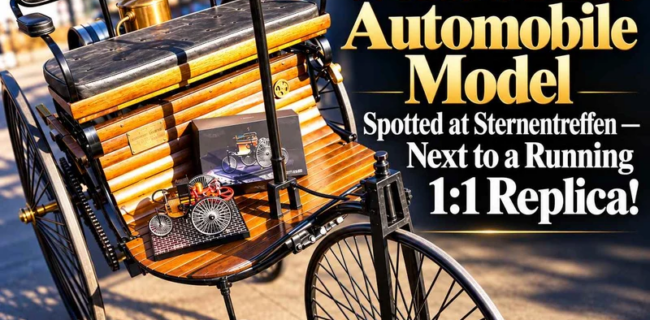
It is celebrating its 140th anniversary this year: The World´s First Automobile, invented by Dr. Carl Benz in Ladenburg near Mannheim, Germany, in 1886. Or that´s at least when he had his gas-powered three-wheeler patented as the Carl Benz Patent Motorwagen. It was the starting point for all the internal combustion cars in the past 140 years, the genesis of everything our hobby revolves around, whatever our personal preferences of evolutionary shape are. In 1:18, it has long been part of my collection and considered to be sufficiently ticked off my must-have list. Little did I know that a 1:10 kit for a working model existed. And when the manufacturer contacted me via my website, I had mixed feelings. Manufacturers next to never offer us free samples. I felt suspicious and a little inclined to accept their offer of a complimentary kit initially. Spending weeks assembling a kit (remembering our recent Pocher review)? Something that was to have a running engine? Something off (my 1:18) scale? As you can see, I finally did accept their offer on the condition that I´d be completely honest about following this Socíety´s ethos and code of honour.
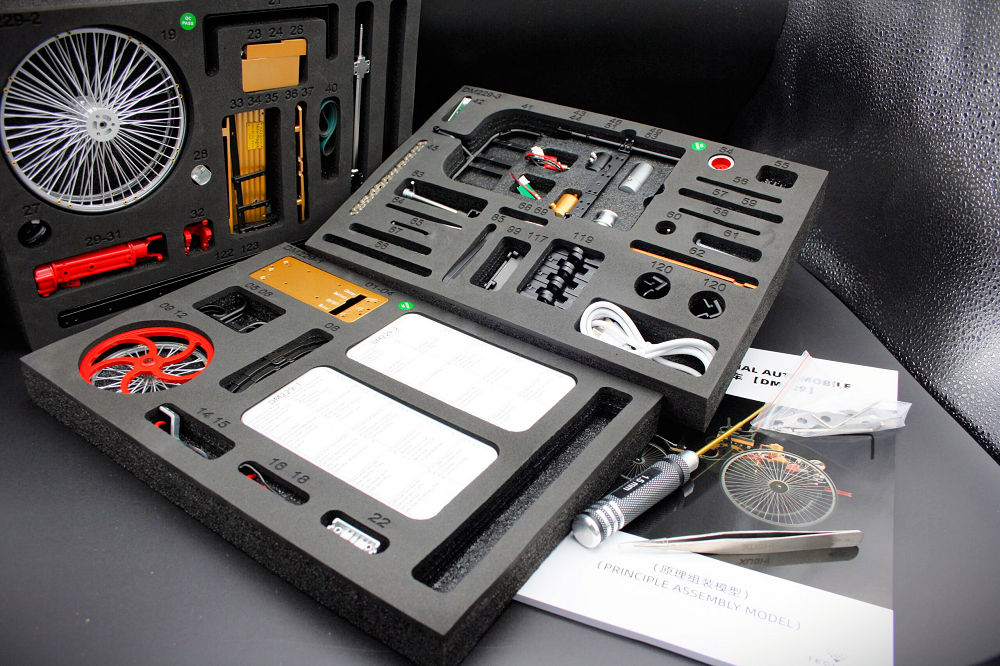
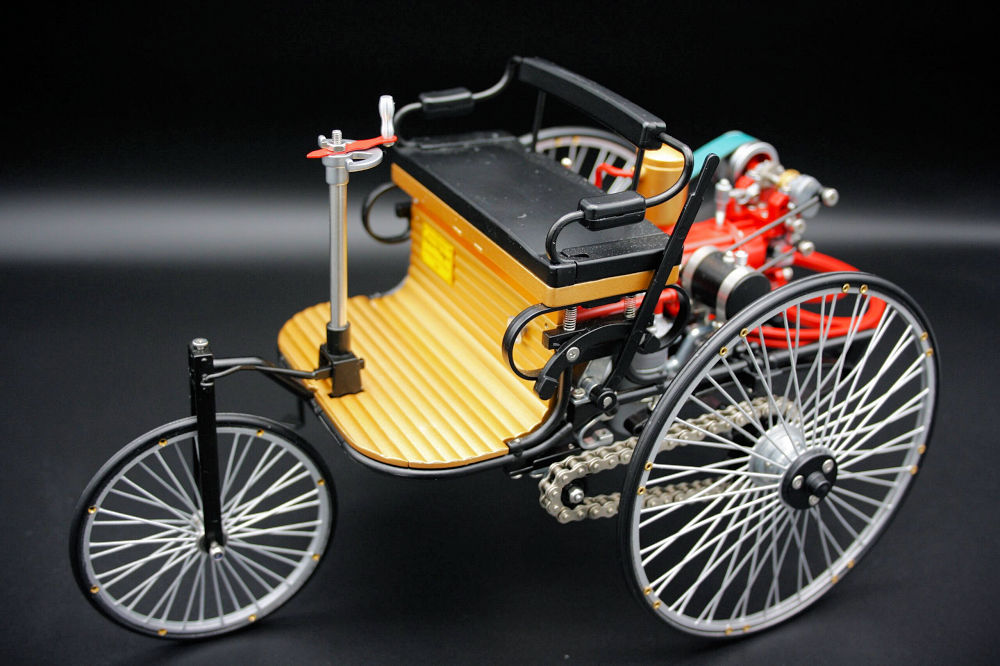
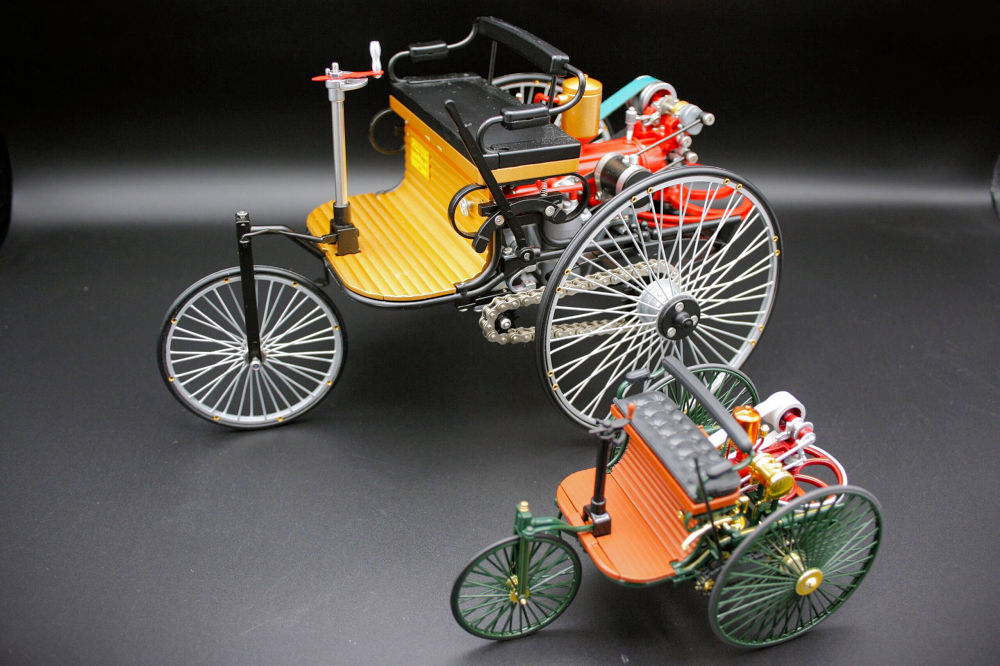
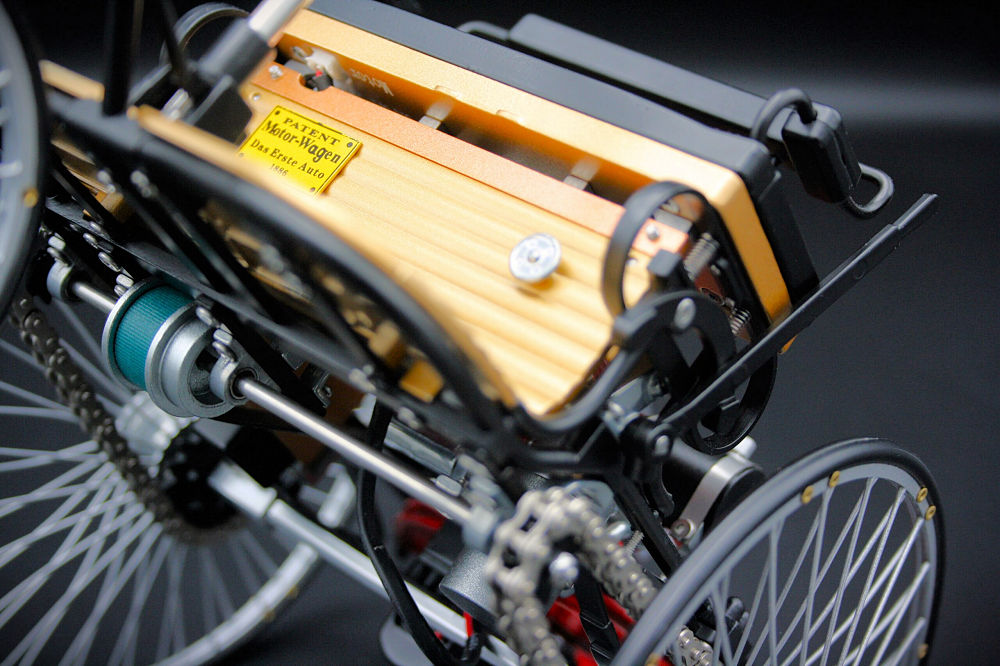
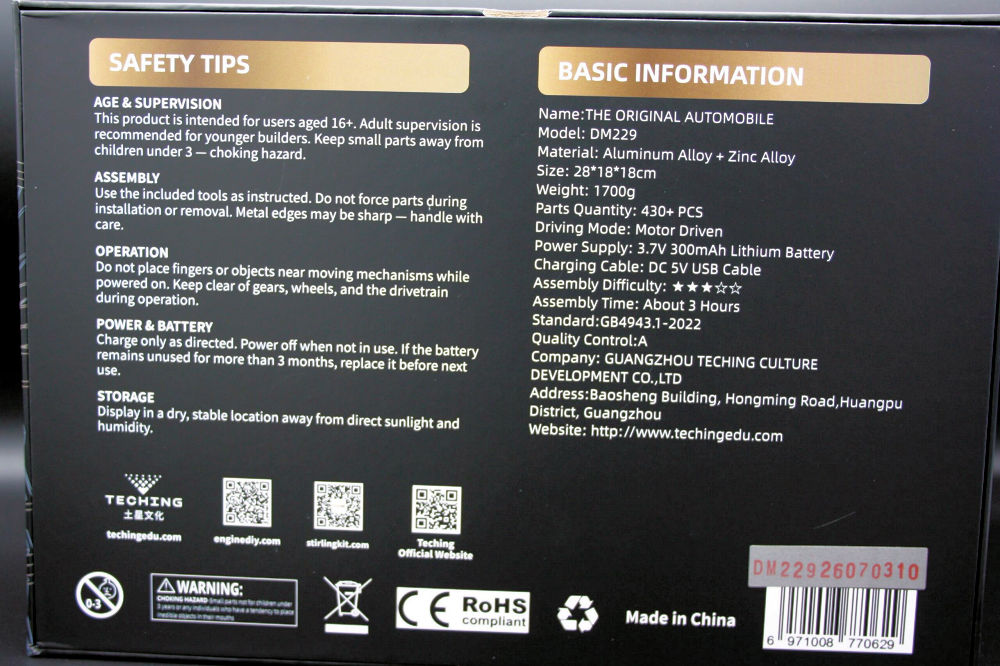
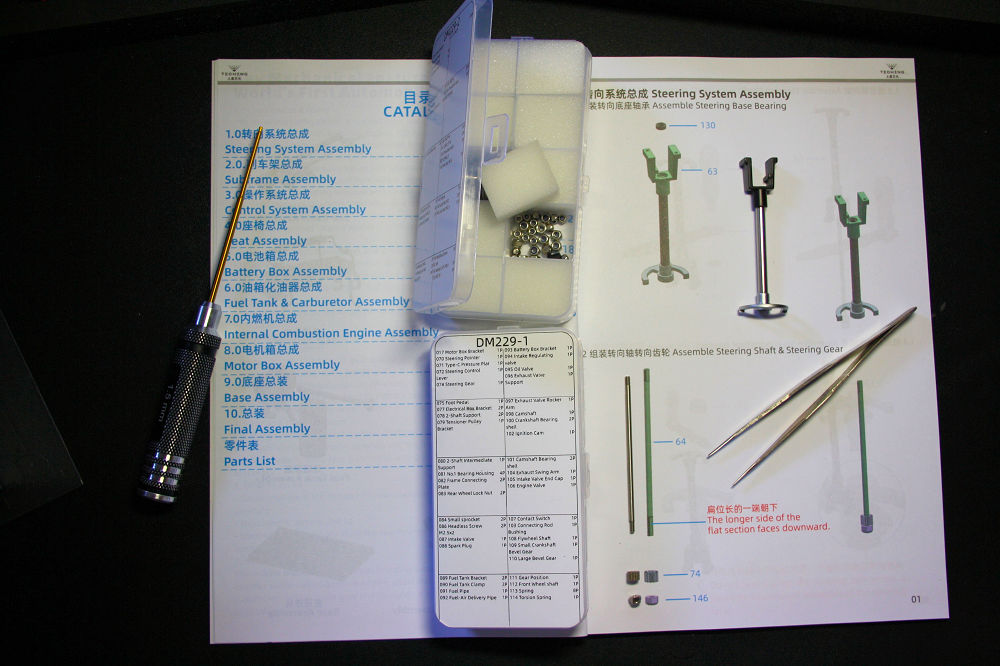
My first positive surprise was unboxing the model. Everything is neatly and very orderly presented in high-quality foam trays like jewellery, smaller parts and screws plastic box trays, each compartment in them covered by more foam. No endless array of plastic bags. In fact, no plastic at all other than the circuit boards and wire coats of the electronics. Everything, really everything else (except for the drive belt obviously) is metal. While this is doubtlessly excellent, solid quality, sometimes different materials would have added more truth to the original and value. The seat and armrest “cushions” are metal, too, whereas plastic on the Norev 1:18 replicates upholstery so much more credibly, and leather would at this scale have killed it. CMC too once did a 1:10 model of the Patent Motorwagen, even though static, of course. The floorboards and the steering handle on the original are wood that is more credibly imitated in plastic. And putting rubber onto the wheels instead of painting metal black would positively affect functionality too. On tiles or wooden floors the vehicle massively understeers, ploughing straight ahead, whatever the steering is set to. Only on thin carpet does the three-wheeler have enough grip to happily circle my coffee table.
But before that it needed assembly, which I dreaded and postponed until another pleasant surprise happened. An email from Stirlingkit´s service arrived, drawing its recipients’ attention to the mere eventuality that some part may have been delivered incomplete, asking them to kindly check and report back if affected; a replacement would then be sent for free. My jaw dropped in awe! Never in my entire almost 40-year history as a collector have I witnessed a 1:18 manufacturer of sometimes models more than twice the price do this.
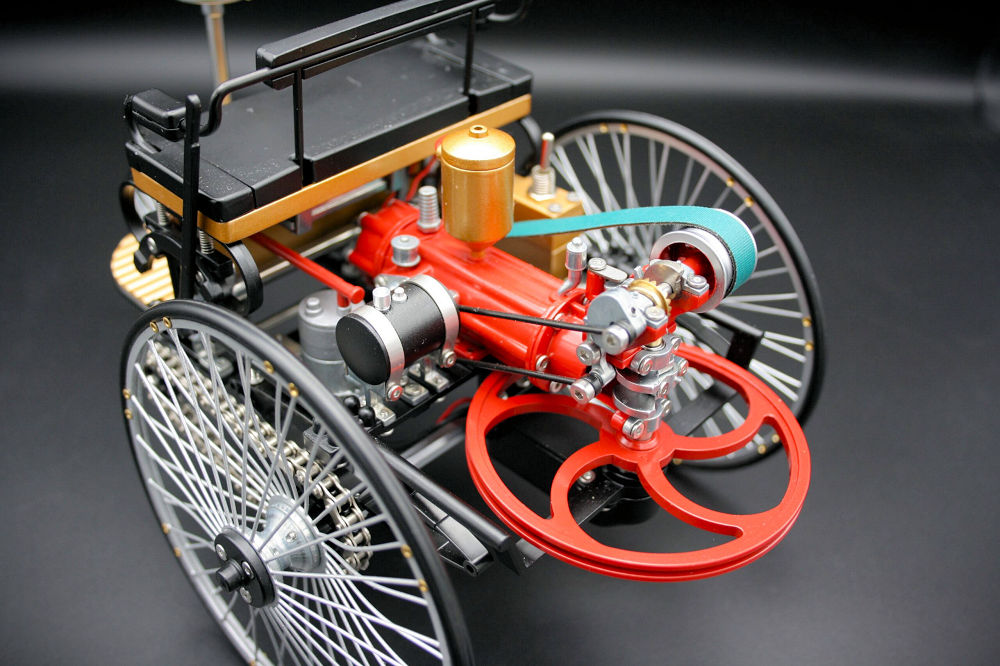
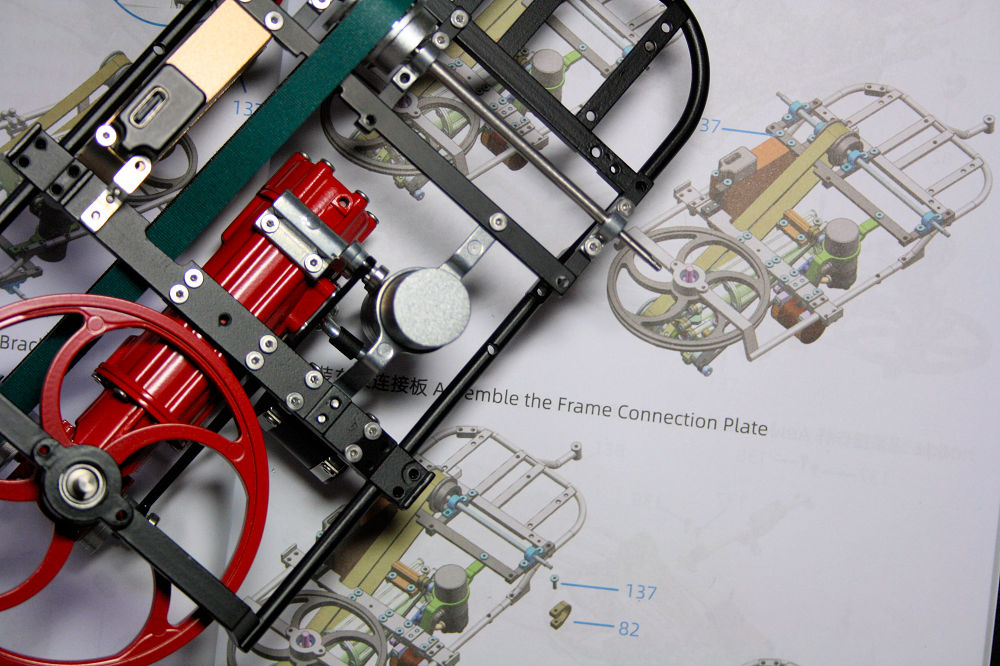
Encouraged, I started the build and found it much easier than the (still unfinished Ixo London Bus). In retrospect, any issue I had has turned out to be my own fault. Actually, the assembly only took me a rainy weekend. The worst issue I found is that neither the screws nor the screwdriver supplied with the kit are magnetic. The 170 screws (part #137) most often used in the assembly kept dropping, which can be unnerving if you don´t know that a dozen of them are supplied in reserve, just like a complete set of springs for the seat and some of the ball bearings (yes, actual tiny ball bearings!). As a 1:18 collector used to sloppy shortcuts and carelessness right past QC, this kit seems uber-overengineered. It has to be kept in mind, though, that Stirlingkit usually offer engine replicas for self-assembly, sometimes replicating a real internal combustion function that leaves no room for error.
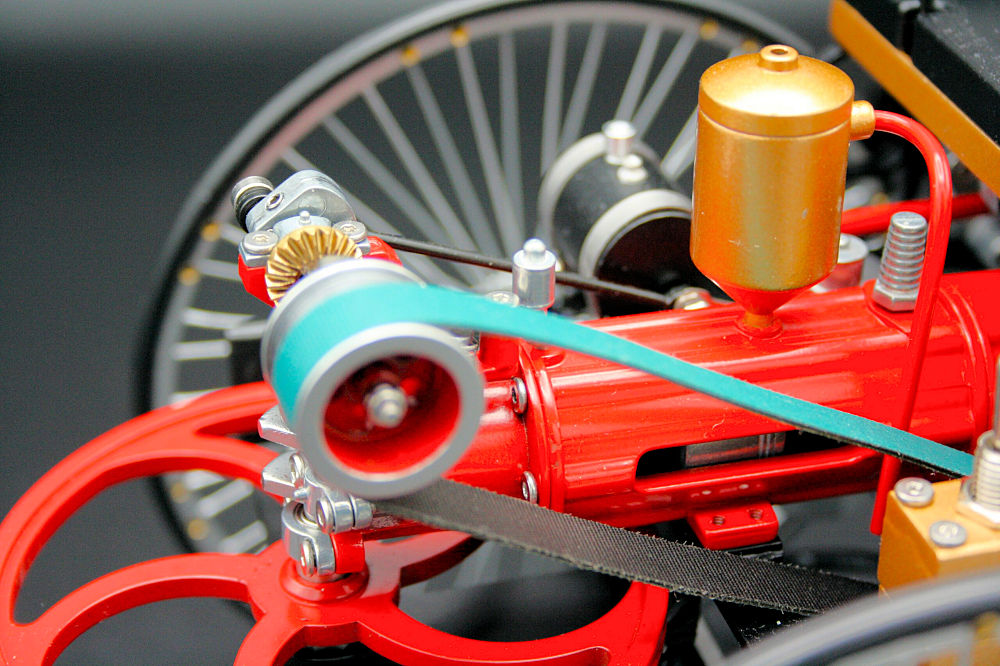
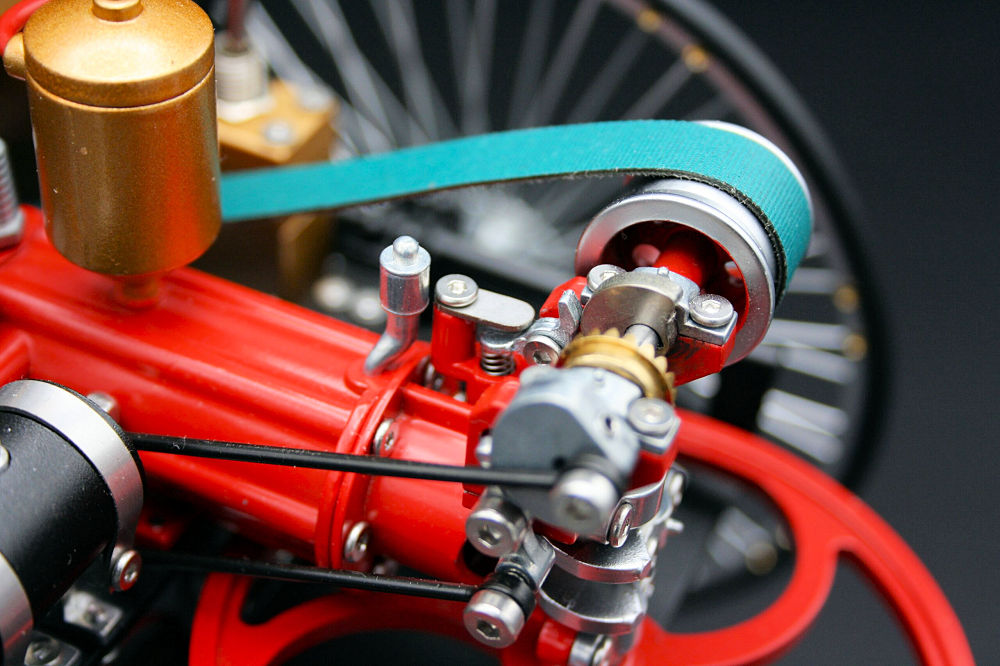
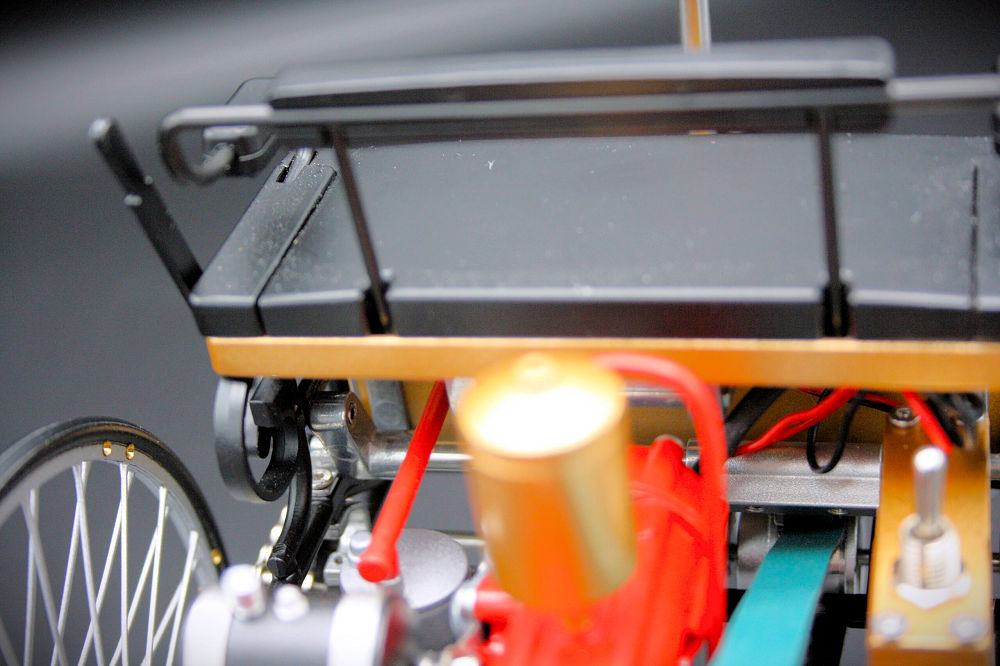
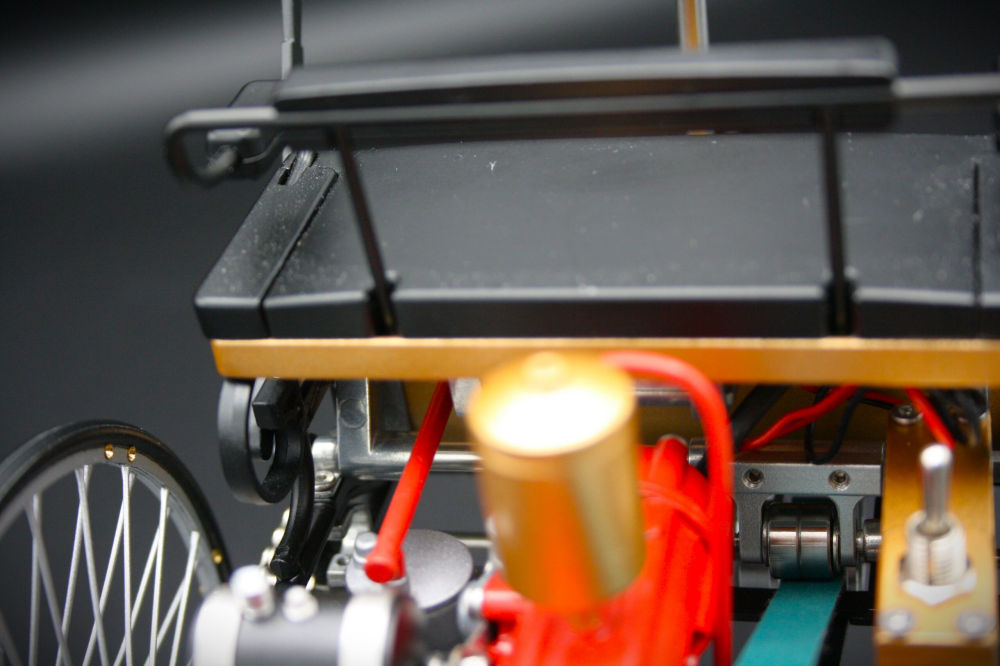
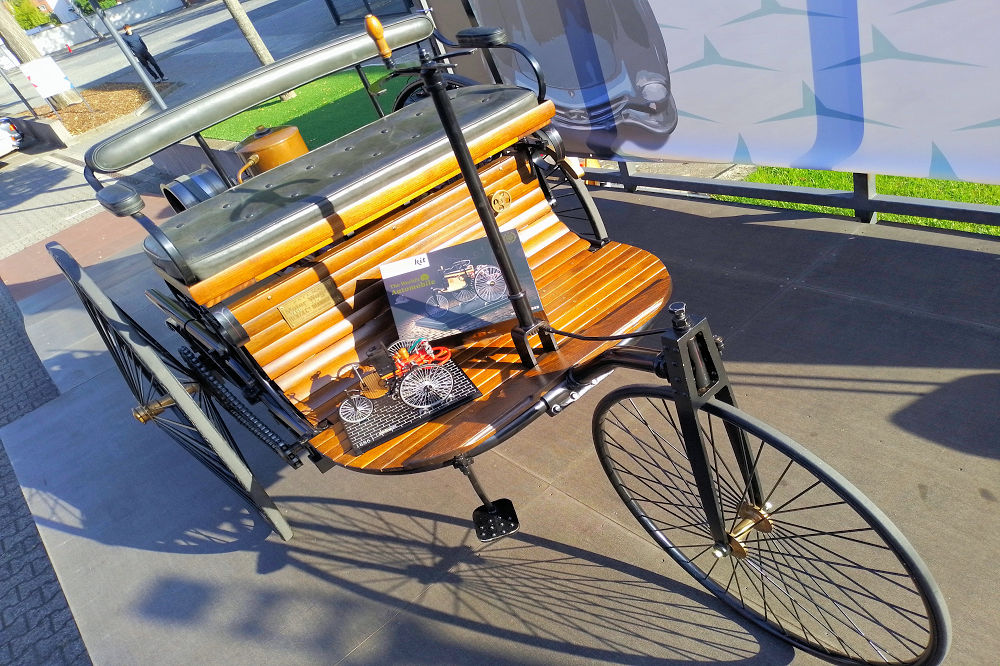
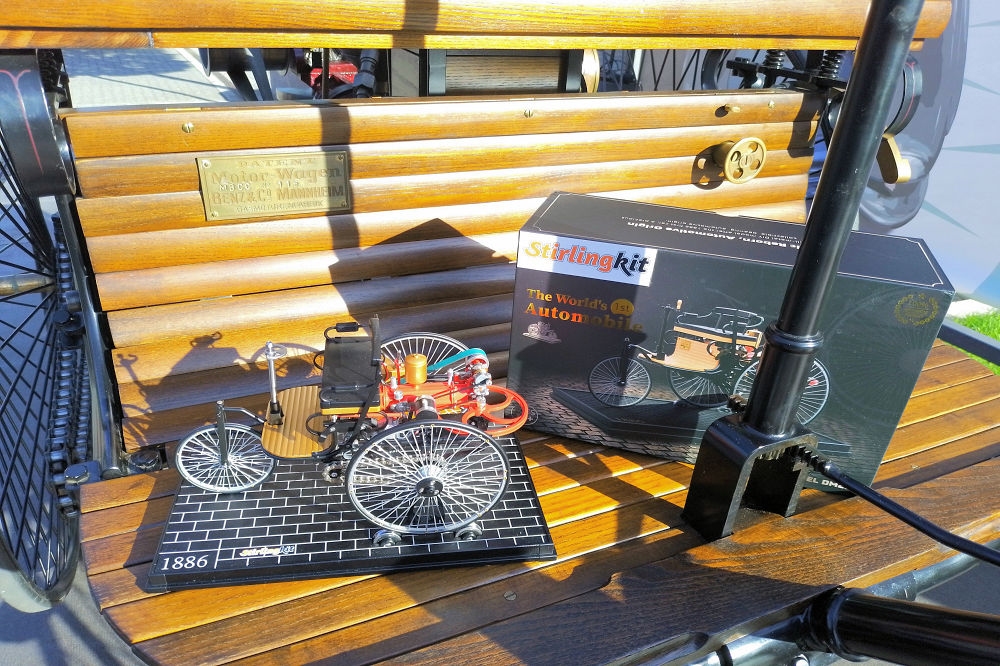
Thankfully, our model only imitates the combustion process with the cylinder cut open to show the piston moving. I had the privilege of seeing a 1:1 replica at a vintage Mercedes car meet in September. It being a replica offered advantages, as it allowed me to get close and personal enough to compare it to the finished model I had brought in foresight. The other advantage was that its curator, who had brought it from the Dr. Carl Benz Automuseum located in the original factory building where this was invented 140 years ago, demonstrated it, showing how to start it up and run it, including a little drive. An invitation to his lunch table, where the experts on the real thing curiously inspected the model, yielded more insight. They found the model being rather well done, with some deviation from how the real vehicle works: Firstly, the flywheel runs the other direction. The drive belt actually runs across (forming the shape of an 8) to cover more surface on the pulleys and generate more grip. In contrast to the model, the real vehicle shifts the belt from a neutral pulley on idle to a pulley driving the driveshaft, while the model merely tightens the belt more on the pulley and slips around it in neutral gear. As on the real vehicle, chains on each side convey the rotation to the real wheels, only that the real car´s chains are much thinner. What has been replicated impressively is how the cylinder piston both runs the pulley for propulsion and the ignition timing. If you ignore the electric engine whirr, it all even sounds a lot like the real engine. One concern of mine is when the battery needs replacing. Stirlingkit do offer replacement batteries, but it would be infinitely easier if they were some standard units available elsewhere. The other concern is all the disassembly necessary to access the battery on the model, as the battery box is true to original (though not wood), but not as easily accessed as on the real car.
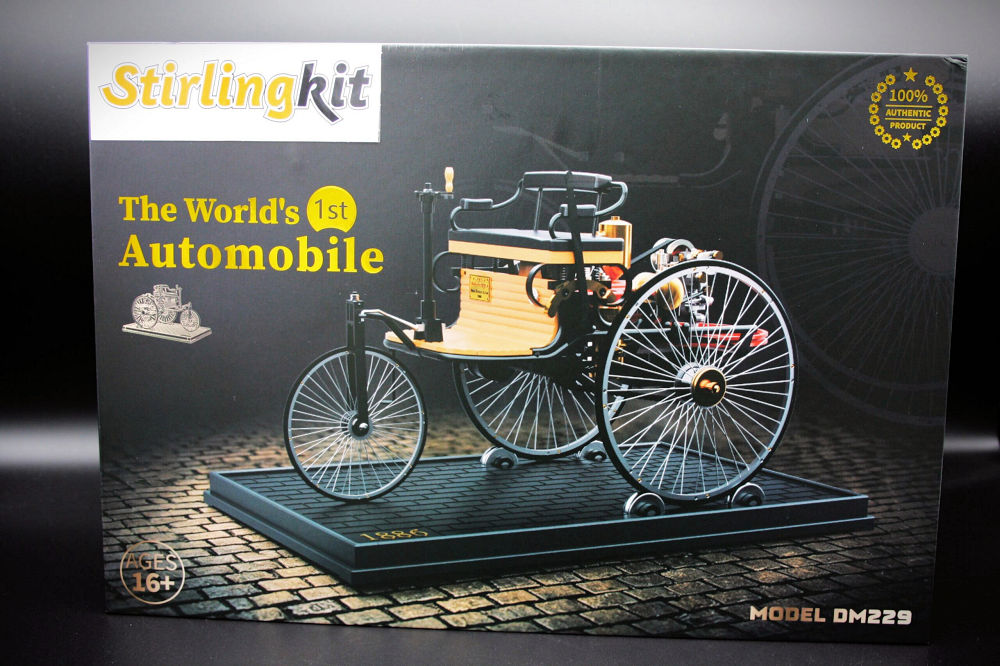
So all in all, contrary to what I expected, it was a wonderful experience. Sophia at Stirlingkit responded to all my input with the greatest enthusiasm and gratitude. They even invited me to join their affiliate scheme, giving you a discount (ad me a commission) if you buy via my link and code. But this profit would turn my hobby into a business with a lot of paperwork. The reason I am sharing this background story with you is to demonstrate how the team on Diecastsociety.com works. It´s our hobby, too, just like yours. Like you, we pour a lot of time, effort and money into the hobby. And any returns for our efforts to share it with you here are rare; at best, what Stirlingkit has given me here is an unprecedented, maybe once-in-a-lifetime, but definitely rewarding experience. Thank you, Sophia!

Glad to hear it was a positive experience from start to finish. Nice to see their support too. The packaging quality and overall construction look uber solid. I agree with your comments about using more authentic materials, like fabrics or leather, for seating.
Thanks for sharing the review!